
 Image 1 of 1
Minimum 10 copies per purchase
In his poem, “Mother O’ Mine,” Rudyard Kipling ponders how, if terrible things were to happen to him, he knows that he’ll always have the comfort of his mother’s love; a juxtaposition of darkness and light, harmful happenings remedied by maternal love.
If I were hanged on the highest hill,
  Mother o' mine, O mother o' mine!
I know whose love would follow me still,
  Mother o' mine, O mother o' mine!
If I were drowned in the deepest sea,
  Mother o' mine, O mother o' mine!
I know whose tears would come down to me,
  Mother o' mine, O mother o' mine!
If I were damned of body and soul,
I know whose prayers would make me whole,
  Mother o' mine, O mother o' mine!
Going beyond the direct mention of the author’s mother, I interpret this poem where “mother” could be any person who, should harm befall you, would absolutely be there to give love and support. If it’s not a mother or father, then it could be a grandparent, other relative, or a teacher or coach.
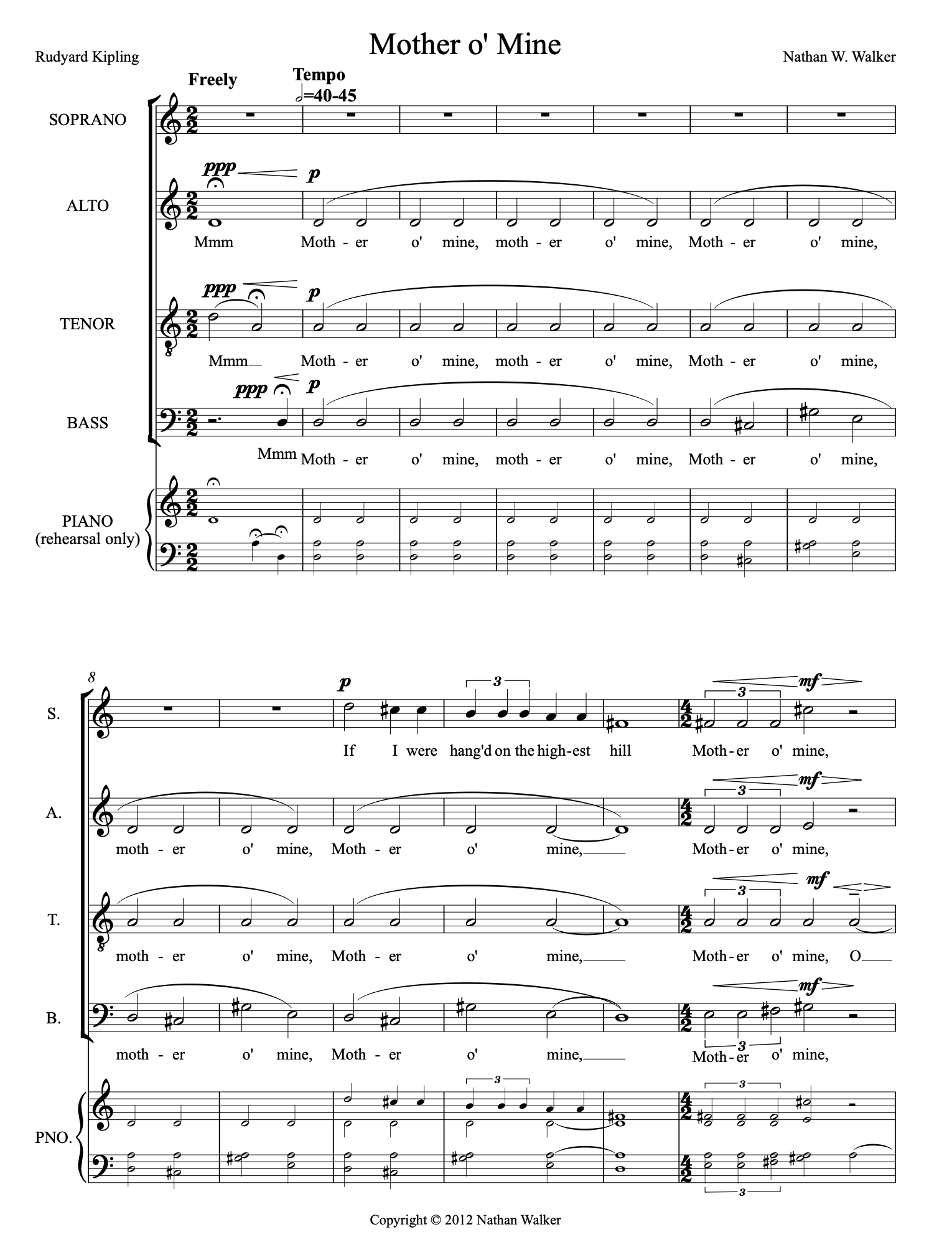
I wrote this piece after graduating with my graduate degree in choral conducting, so you may find this piece a bit more adventurous than my other work. Mother O’ Mine is deceptively difficult. The opening pedal harmony teases a major or minor scale, but, while the Tenors and Altos continue to the pedal, the Basses sprinkle in a raised 4th. This Lydian mode lends the peace a tonality that is familiar enough to be comfortable, yet enough sparkle to add some colorful dissonance. Also, the Basses foreshadow how there will be leaps into dissonances that later resolve.
The author’s comforting, centering chant of, “Mother o’ mine…” continues throughout most of the piece. I chose this direction as a means of expressing Kipling’s point about how, regardless of what happens, his mother’s love is omnipresent.
For rhythmic interest, I am a lifelong fan of 2-against-3 as it adds an element of simple, rhythmic tension whenever it happens. Triplets provide the meat of rhythmic momentum throughout, with quarter-note and half-note triplets trading off amongst the parts. Half-note triplets can be tricky when tempo is slow and half notes get the beat, especially if the half-note triplet begins with a quarter note.
In his poem, “Mother O’ Mine,” Rudyard Kipling ponders how, if terrible things were to happen to him, he knows that he’ll always have the comfort of his mother’s love; a juxtaposition of darkness and light, harmful happenings remedied by maternal love.
If I were hanged on the highest hill,
  Mother o' mine, O mother o' mine!
I know whose love would follow me still,
  Mother o' mine, O mother o' mine!
If I were drowned in the deepest sea,
  Mother o' mine, O mother o' mine!
I know whose tears would come down to me,
  Mother o' mine, O mother o' mine!
If I were damned of body and soul,
I know whose prayers would make me whole,
  Mother o' mine, O mother o' mine!
Going beyond the direct mention of the author’s mother, I interpret this poem where “mother” could be any person who, should harm befall you, would absolutely be there to give love and support. If it’s not a mother or father, then it could be a grandparent, other relative, or a teacher or coach.
I wrote this piece after graduating with my graduate degree in choral conducting, so you may find this piece a bit more adventurous than my other work. Mother O’ Mine is deceptively difficult. The opening pedal harmony teases a major or minor scale, but, while the Tenors and Altos continue to the pedal, the Basses sprinkle in a raised 4th. This Lydian mode lends the peace a tonality that is familiar enough to be comfortable, yet enough sparkle to add some colorful dissonance. Also, the Basses foreshadow how there will be leaps into dissonances that later resolve.
The author’s comforting, centering chant of, “Mother o’ mine…” continues throughout most of the piece. I chose this direction as a means of expressing Kipling’s point about how, regardless of what happens, his mother’s love is omnipresent.
For rhythmic interest, I am a lifelong fan of 2-against-3 as it adds an element of simple, rhythmic tension whenever it happens. Triplets provide the meat of rhythmic momentum throughout, with quarter-note and half-note triplets trading off amongst the parts. Half-note triplets can be tricky when tempo is slow and half notes get the beat, especially if the half-note triplet begins with a quarter note.
Minimum 10 copies per purchase