

Featured Works
More music coming soon!
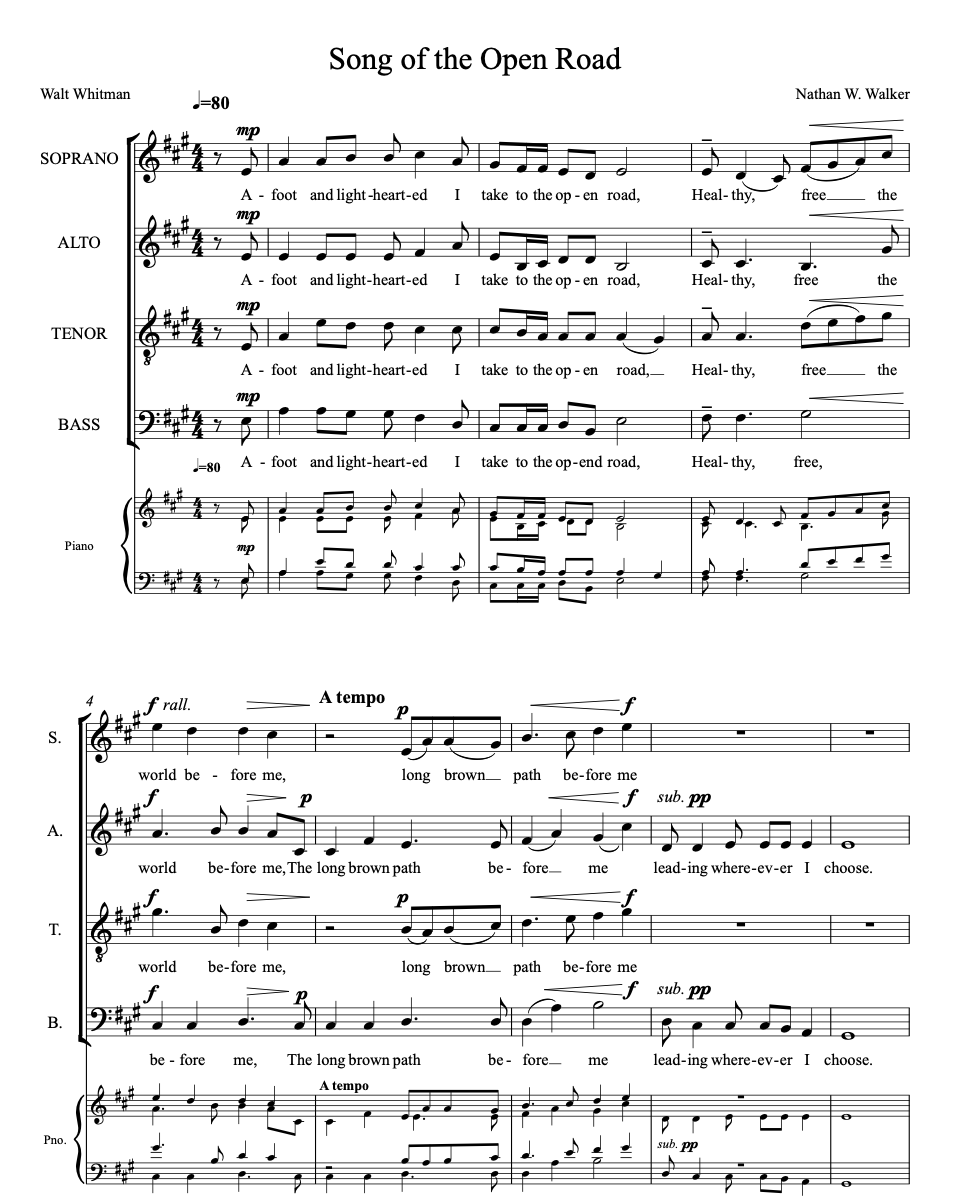
This piece for SATB choir (with divisi) is an expression of Walt Whitman’s masterful “Song of the Open Road”:
Afoot and light-hearted I take to the open road,
Healthy, free, the world before me,
The long brown path before me leading wherever I choose.

Henceforth I ask not good-fortune, I myself am good-fortune,
Henceforth I whimper no more, postpone no more, need nothing,
Done with indoor complaints, libraries, querulous criticisms,
Strong and content I travel the open road.

The earth, that is sufficient,
I do not want the constellations any nearer,
I know they are very well where they are,
I know they suffice for those who belong to them.

(Still here I carry my old delicious burdens,
I carry them, men and women, I carry them with me wherever I go,
I swear it is impossible for me to get rid of them,
I am fill’d with them, and I will fill them in return.)
This is a text that I connected with immediately upon first read (see below) and I hope that you and your singers will take note of Whitman’s expression of excitement towards the path ahead. In particular, his statements describe a person who is self-assured and sure footed. They don’t need anything else to begin their quest but the earth beneath them.
I believe that most SATB choirs will find plenty to sink their teeth into, both musically and through Whitman’s lovely prose.
Composer’s Notes
Song of the Open Road, written during my final undergraduate year at East Carolina University, is a piece that will always be near and dear to my heart. Written originally for my senior music composition recital and then performed live at the ECU School of Music graduation ceremony, I searched and searched for a poem about forging ahead into the unknowns of the real world. At first read of Whitman’s text, I knew I had found the one!
The opening statements of the piece showcase the determination of the first line, “Afoot and lighthearted I take to the open road… Healthy, free, the world before me…”. These words found resonance with me at the time, when, as young, healthy, vibrant 22-year-old I saw the vast expanse of the world as a blank canvas just waiting to be painted. I felt unstoppable (who doesn’t when they’re in their early 20’s). “The long, brown path before me leading wherever I choose” - Yes! As a young music student who was hungry for life and adventure, about to run away to graduate school, I felt as if I was the master of my destiny; “leading wherever I choose”.
In between these statements of confidence, which recall the opening material each time, the journeyman, the traveler, the young, adventurous soul that is the voice of the poetry, has short moments of reflection. “The earth, that is sufficient. I do not want the constellations any nearer…”, to me, is Whitman expressing the sentiment of mindfulness, of grounding oneself, knowing you’re about to embark on something big.
Still, even though our young traveler is ready and willing to hit the open road before them, there’s an acknowledgment that they are not free from the burdens and experiences of their past. “Still here I carry my old delicious burdens… I carry them with me wherever I go.” “Delicious burdens”? What an exquisite turn of phrase!
I found myself writing lines to Whitman’s text that are constantly pairing one voice, or pair of voices, against another as one voice holds and another voice moves up or down around them. In this way, the lines grant a motion to the work, even with rhythmic interest is not as dense. The work dances around the key of A Major but never loses its footing in the key from whence it began. There’s a lot of room for choirs to sing with full voice and enough contrasting, more reflective moments that give singers the opportunity be expressive at lower dynamics.
While, of course, I hope that singers and audiences alike enjoy the music, I mostly find myself wanting others to connect to the text in the same way that I did so long ago.
Even as we grow older, more experienced with life, and hopefully wiser, may we never lose that sense of adventure that propels us ahead.
I’ve always held a place in my heart for poetry about love, so when I stumbled across the text of “The Roving Lover” by F. R. Higgins, I felt that keen spark of fascination that strikes you whenever you encounter a work that you connect with immediately.
If my Love came down from the Mourne hills
To the edge of the white-wood lake,
And hid her head on my pillow now
Before the birds awake,
I would string the stars on a blade of grass
And make my Love a crown
And I’d give my soul for a little kiss
To the girl from the County Down.
I have roamed the roads with my paltry songs
And a wattle in my hand,
But her kindly eyes have led me on
Through a gold and holey land;
And the words I’ve heard from the noblemen
And the dames of Dublin town
Are cold beside the burning words
Of the girl from the County Down.
Higgins’ words are elegant, the phrasing of a daydreaming lover who’s pining for “the girl from the County Down”. I’m particularly struck how he crafts specific lines, such as, “I would string the stars on a blade of grass / And make my Love a crown”. Then, to follow that up with another statement, “I’d give my soul for a little kiss”. What gorgeous writing!
F. R. Higgins was clearly no stranger to vivid imagery and I find his words remarkably effective. I hope you will enjoy his poetry as well and find this work a proper setting of his expressions.
Composer’s Notes
At this point in my life I was singing choir works and studying solo voice, so I was keen to write lines that I, as a singer, would want to sing. I don’t see this work as being terribly difficult for most SATB ensembles, but some vocal lines and dissonances could pose a challenge at first.
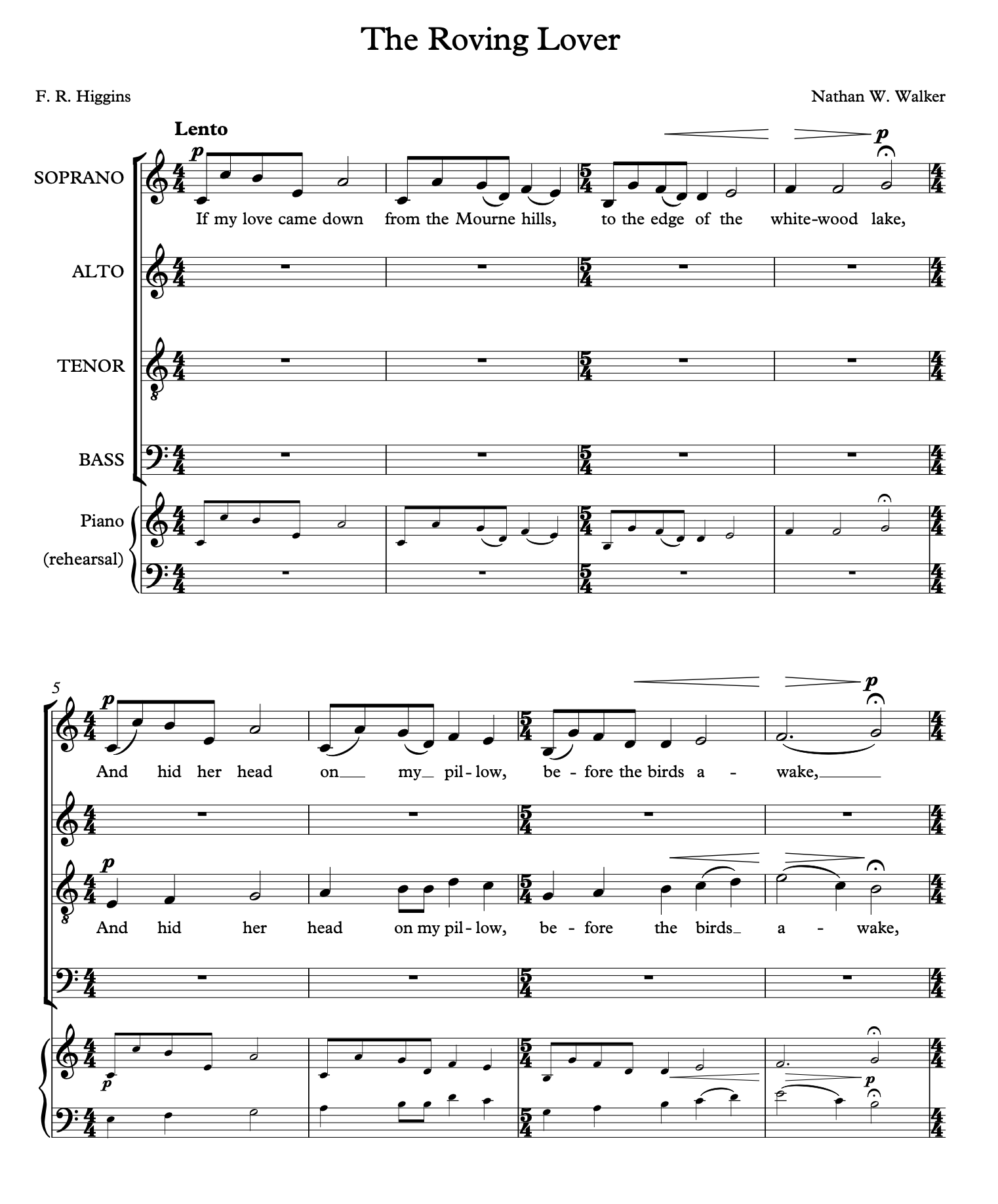
If you look at the opening page of the music (shown here in the image), the Sopranos introduce a vocal line that climbs up and down a hillside; nothing too crazy, yet enough elevation change to build melodic interest. Then, the Tenors join in, drawing a longer, upward slope of another hill. As all the voices join, the notes on the page depict a hillside of varying rises and falls, just how I imagine one might see in a real Irish landscape.
Tonally, the piece is basically a long-winding, downhill walk from C Major down to Bb-flat Major. Most of the work lives in a major key tonality with a brief departure into F Minor as we snake over to Eb-flat Major for the final, climactic moment.
This is one of my favorite works and I hope you enjoy singing it! I’d love to hear your thoughts.
Written & premiered at Louisiana State University by the LSU Choral Scholars, 2014
In his poem, “Mother O’ Mine,” Rudyard Kipling ponders how, if terrible things were to happen to him, he knows that he’ll always have the comfort of his mother’s love; a juxtaposition of darkness and light, harmful happenings remedied by maternal love.
If I were hanged on the highest hill,
  Mother o' mine, O mother o' mine!
I know whose love would follow me still,
  Mother o' mine, O mother o' mine!
If I were drowned in the deepest sea,
  Mother o' mine, O mother o' mine!
I know whose tears would come down to me,
  Mother o' mine, O mother o' mine!
If I were damned of body and soul,
I know whose prayers would make me whole,
  Mother o' mine, O mother o' mine!
Going beyond the direct mention of the author’s mother, I interpret this poem where “mother” could be any person who, should harm befall you, would absolutely be there to give love and support. If it’s not a mother or father, then it could be a grandparent, other relative, or a teacher or coach.
Composer’s Notes
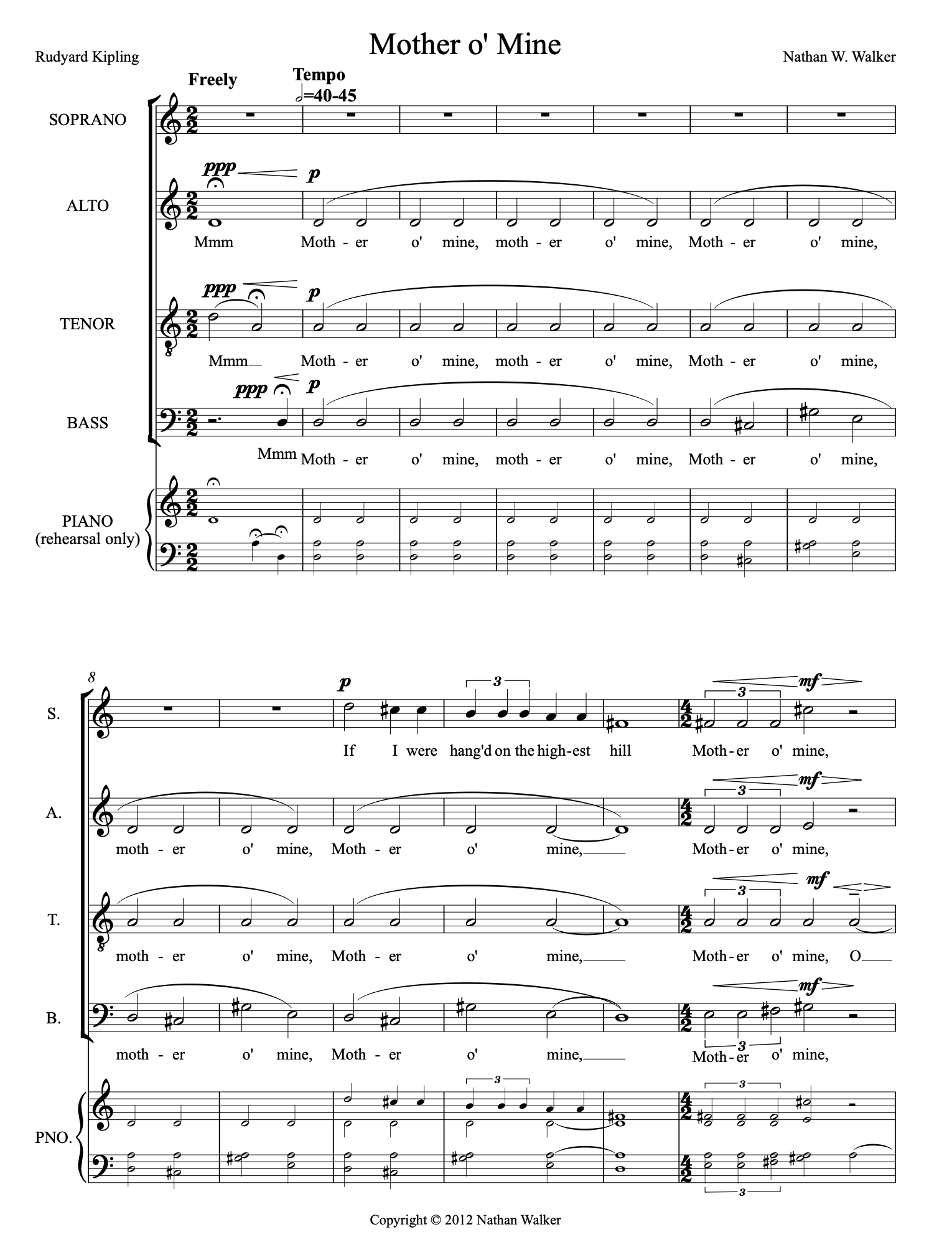
I wrote this piece after graduating with my graduate degree in choral conducting, so you may find this piece a bit more adventurous than my other work. Mother O’ Mine is deceptively difficult. The opening pedal harmony teases a major or minor scale, but, while the Tenors and Altos continue to the pedal, the Basses sprinkle in a raised 4th. This Lydian mode lends the peace a tonality that is familiar enough to be comfortable, yet enough sparkle to add some colorful dissonance. Also, the Basses foreshadow how there will be leaps into dissonances that later resolve.
The author’s comforting, centering chant of, “Mother o’ mine…” continues throughout most of the piece. I chose this direction as a means of expressing Kipling’s point about how, regardless of what happens, his mother’s love is omnipresent.
For rhythmic interest, I am a lifelong fan of 2-against-3 as it adds an element of simple, rhythmic tension whenever it happens. Triplets provide the meat of rhythmic momentum throughout, with quarter-note and half-note triplets trading off amongst the parts. Half-note triplets can be tricky when tempo is slow and half notes get the beat, especially if the half-note triplet begins with a quarter note.
contact
If you’re interested in a commission, discussing possible collaborations, have questions about purchasing a piece of music, or anything else that comes to mind, please don’t hesitate to reach out!
Fill out the contact form with as much detail as possible and I’ll respond as soon as I can.